
AI-enabled eye care saves sight in remote Bangladesh
An artificial intelligence (AI) eye screening initiative, built on open-source technology developed at University College London and Moorfields Eye Hospital NHS Foundation Trust, is bringing essential eye care to isolated island communities in southern Bangladesh, where most people have never been examined by an optometrist or ophthalmologist.
Shortly before 1pm on 11 December 2025, at a mobile eye camp set up in a cyclone shelter on Char Nizam, Kalam Chowkider leaned into a fundus camera. A light flashed, capturing a high-resolution image of his retina. Before he lifted his head, an AI system was already scanning the image for disease. By the time he reached his tin-roofed hut, a specialist 7,600 kilometres away in Germany, was studying the same image alongside the AI report. The diagnosis was diabetic retinopathy.

Kalam lives on Char Nizam, one of many fragile river islands, or chars, at the southern tip of Bhola, a remote coastal district in Bangladesh’s Meghna Estuary. The silt-and-sand chars of Bhola district are home to 1.9 million people. Many of the smaller chars, including Char Nizam and Dhal Char, have no roads, no grid electricity and no health centre. Reaching a doctor means a boat trip to the mainland of up to four hours, dependent on tides and weather, or a private boat costing a month's food. As a result, diabetic retinopathy and other sight-threatening conditions often go undetected until vision loss is irreversible.
To tackle the problem, the Amar Chokh Amar Alo (“My Eyes My Light”) programme was launched in January 2025 in Char Fasson, with satellite outreach camps to reach remote chars including Char Hasan, Char Nizam and Dhal Char. The initiative is a community-led partnership of clinicians, data scientists and NGOs, co-founded by Hasib Rahman of San-Francisco-based data and AI firm Data Yakka, and Randall Stafford of Stanford University. Together they built a framework for delivering AI-enabled screening and vision care to marginalised populations.
From London AI lab to island clinic
The screening tool is built on RETFound, an AI foundation model for retinal disease detection developed by researchers in Professor Pearse Keane's group at the UCL Institute of Ophthalmology and Moorfields Eye Hospital NHS Foundation Trust. Trained on 1.6 million images curated by the INSIGHT Eye and Oculomics Health Data Research Hub at Moorfields, RETFound was released open source in September 2023 for non-commercial research use, to accelerate global efforts to prevent blindness.
With advice from Professor Keane’s group, the team in Bangladesh finetuned RETFound on more than 3,000 locally collected retinal colour fundus photographs to build a local AI screening model for diabetic retinopathy, with improved relevance and performance for Bangladeshi populations. In a few months, the AI model moved from the lab into a pilot in underserved communities, a critical first step towards eventual frontline clinical use.
Mobile AI clinics run by satellite link
Trained field staff carry portable, high-resolution fundus cameras and AI-enabled devices to mobile clinics set up in cyclone shelters and repurposed schools on the islands, such as the one Kalam attended on Char Nizam. Retinal images are analysed by the AI system within seconds, flagging suspected disease, before being sent to a remote network of ophthalmologists who review the results and confirm the diagnosis. Establishing reliable connectivity took weeks of preparatory work, including a partnership with device maker Topcon to test equipment and power supply, and a satellite link to strengthen the islands' fragile mobile networks.

In the field, the AI system provides an initial assessment of each person’s image, flagging those suspected of having eye disease. The images are then sent remotely to eye specialists to determine whether a patient needs treatment or referral to a hospital on the mainland. The model is used in conjunction with a secure patient management portal developed by Data Yakka, a philanthropic partner in the initiative.
Impact and national approval
Since the pilot began in January 2025, the programme has screened more than 42,000 people across Char Fasson Upazila in Bhola District, reaching some of Bangladesh's hardest-to-reach coastal chars and riverine communities, including Dhal Char, Char Hasan, Kolatoli, and Char Nizam. In the most remote chars, 80–90% of patients had never previously received eye screening or treatment.
By June 2026, reported service data showed that 59% of patients were women, 15,131 were above the age of 50, 18,024 reading glasses had been provided, 5,003 cataract patients had been identified for surgery, 951 cataract operations had been completed, and 2,529 cases of eye disease had been detected, including age-related macular degeneration (AMD), glaucoma, diabetic retinopathy, and hypertensive retinopathy.
The local AI initiative has received clearance from Bangladesh's Ministry of Health and Family Welfare for test deployment across additional community vision centres in coastal Bangladesh, with all clinical decisions remaining under human supervision. The approach has drawn early interest from other low- and middle-income settings, including the Government of Sierra Leone.
Md. Saidur Rahman, former Secretary, Health Services Division, Ministry of Health and Family Welfare, said: "When the vision care model was presented by the Data Yakka and Amar Chokh Amar Alo team, what convinced us was its community-led, human–AI hybrid approach—where artificial intelligence supports ophthalmologists, not replaces them."
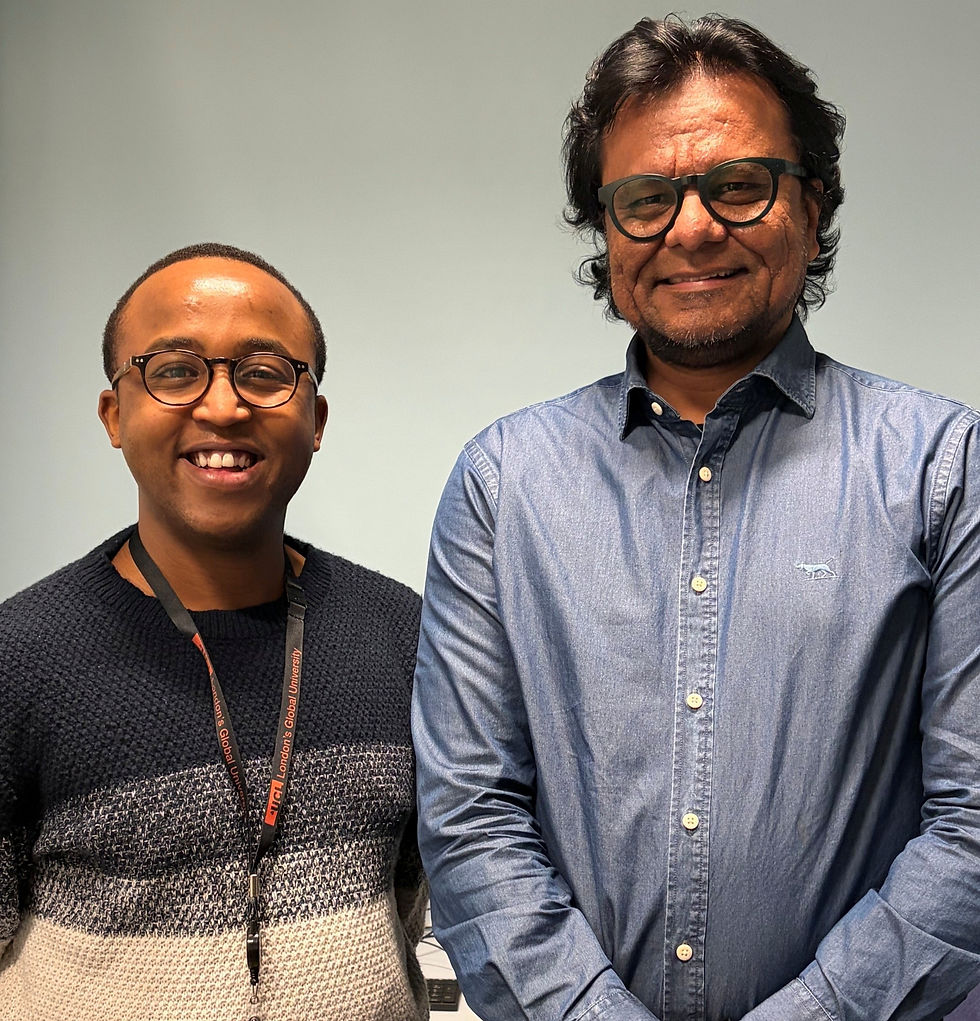
Hasib Rahman, who co-leads the Amar Chokh Amar Alo initiative, said: “In collaboration with social scientists, NGO leaders, AI pioneers, and strategic financial advisors, we have developed a cost-effective ‘human plus AI’ service model for eye care. This initiative aims to reach some of the most underserved, marginalised communities in Southeast Asia’s coastal areas. In these remote places at the edge of Bangladesh, AI is helping to reach people who were never reachable before.”
Professor Pearse Keane said: "When we published RETFound as an open-source model, we hoped it would be adopted by researchers and clinicians around the world, so it is tremendous to see what the team in Bangladesh has achieved. By fine-tuning the model on locally collected retinal images, they have shown exactly how a foundation model should work in practice: adapted to the population it serves, embedded in a community-led service, and used responsibly with human oversight.”
All images (except portrait) courtesy of Amar Chokh Amar Alo
About Amar Chokh Amar Alo
Amar Chokh Amar Alo (My Eyes My Light) is a community-led programme delivering vision care to underserved populations in Bangladesh. The programme brings together clinicians, data scientists, social scientists, NGO leaders and strategic partners to design and deploy affordable, ethical AI-assisted eye screening in some of the most remote and marginalised communities in the country. The Amar Chokh Amar Alo team worked with the Bangladesh Disaster Preparedness Centre (BDPC) and the Cyclone Preparedness Programme (CPP), whose decades of local trust were used to adapt the model for the region, with clinical input from Dr K. Zaman of BNSB Eye Hospital.
About Data YakkaData Yakka is a Data and AI company from the San Francisco Bay Area, with its main office in Palo Alto and a regional office in Sydney. The company was co-founded by Hasib Rahman, a data and AI strategist, and Professor Randall Stafford from Stanford University School of Medicine. The company’s aim is to combine data science with medical expertise to deliver affordable, transformative solutions for underserved populations yet to fully benefit from advanced AI.
About RETFound
Released open-source on the GitHub repository for non-commercial research purposes, RETFound is an AI foundation model for retinal images. It is a research tool and is not regulated for frontline clinical use. More information can be found here.
About Moorfields Eye Hospital NHS Foundation Trust
Moorfields Eye Hospital NHS Foundation Trust is one of the leading providers of eye health services in the UK and a world class centre of excellence for ophthalmic research and education. Our main focus is the treatment and care of NHS patients with a wide range of eye problems, from common complaints to rare conditions that require treatment not available elsewhere in the UK. Our unique patient case mix and the number of people we treat mean that our clinicians have expertise in discrete ophthalmic sub-specialties.
We treat people in 20 locations in and around London, the south east and Bedford, enabling us to provide expert treatment closer to patients’ homes. We also operate commercial divisions that provide care to private patients in both London and the Middle East.
With our academic partners at the UCL Institute of Ophthalmology, Moorfields is recognised as a leading centre of excellence in eye and vision research. Together we form one of the largest ophthalmic research sites in the world, with the largest patient population in Europe or the USA. We publish more scientific papers than any other eye and vision research site and have an extensive joint research portfolio. For more information please visit https://www.moorfields.nhs.uk/
About UCL Institute of Ophthalmology
The UCL Institute of Ophthalmology is one of a number of specialised research centres within UCL (University College London) and is, together with Moorfields Eye Hospital, one of the leading centres for eye research worldwide. The combination of the institute’s research with the resources of Moorfields Eye Hospital opens the way for advances at the forefront of vision research. Close collaboration with other academic partners and with industry extends its impact. The institute has been named as the best place to study ophthalmology in the 2017 Centre for World University Rankings (CWUR). For more information, please visit www.ucl.ac.uk
About the INSIGHT Eye and Oculomics Health Data Research Hub
INSIGHT is the world's largest ophthalmic imaging bioresource, with over 30 million eye images linked to clinical data. An NHS initiative founded in 2019 and led by Moorfields Eye Hospital, INSIGHT makes routinely collected patient eye data available for approved research that could lead to improvements in diagnosis, care and treatment of eye diseases, as well as systemic disease such as stroke and dementia. INSIGHT’s mission is to improve healthcare for the benefit of patients, the NHS and wider society by enabling safe and trusted research access to anonymised data for research and innovation. For more information, please visit https://www.insight.hdrhub.org/


