
Scaling Oculomics
Updated: 6 days ago
The birth of Oculomics, catalysed by high-resolution eye imaging and the power of data science, has inspired hundreds of studies associating biomarkers in the eye with systemic disease, but has also raised questions over how to translate its promise into public health impact. In this analysis of the health data landscape, we assess the challenges and opportunities for bringing Oculomics into patient care.
The literature on Oculomics has expanded rapidly, from the first paper by Siegfried Wagner and co-authors in 2020, which coined the term “Oculomics”, to over 600 papers published since then. More than 80 percent of that output is from 2024 - 2026, as momentum in the field has accelerated. The vast majority of papers are from the US, China and UK, with Moorfields Eye Hospital and UCL Institute of Ophthalmology (IoO) responsible for more than a quarter of total Oculomics research over the past six years.
Alongside the expanding number of studies, several dedicated courses are now offered by specialist providers, including EURETINA. Endeavours such as the National Institute of Health’s Venture Program Oculomics Initiative in the US, launched in 2024, the Oculomics working group of the Collaborative Community on Ophthalmic Innovation, the Alliance for Healthcare from the Eye, and the Consortium for Vision and Oculomics in Psychiatry have reinforced the idea of Oculomics as a pathway to earlier disease detection, prevention and treatment.
Although the field is demonstrating great potential, doubts have been raised about the performance and patient benefit of some models. For example, studies reporting cardiovascular risk from a retinal image may be using information correlated with age and sex, rather than information specific to cardiovascular disease. It is also questionable what value such a finding would add beyond standard CVD risk calculators, and how actionable any results would be on the patient pathway.
A 2022 paper from John Hopkins University found that deep learning models reliably predict age, sex, and cardiovascular events from retinal images, but consistently underperform on other systemic variables, suggesting that training data may not support precise, disease-specific prediction. Retinal age gap models, estimating the biological age of a person’s retina compared with their chronological age, have also been queried, both for their clinical utility and accuracy. One evaluation showed that a retinal age gap model run on the same eye, photographed twice within minutes, yielded retinal age estimates over two years apart.
Part of the problem may be inadequate testing for confounding factors, along with poorly labelled training data of insufficient scale and diversity, lack of independent external validation, and how actionable these models are the patient pathway.
A wide-ranging review from 2025 highlighted that most algorithms had never undergone external validation in real-world clinical settings. Domain shift was another issue: a biological-aging model trained on a Korean population lost accuracy when tested on the mostly Caucasian UK Biobank cohort. It also flagged labeling as a bottleneck, since grading retinal images for systemic disease often demands expertise beyond ophthalmology.
Another review of 36 ophthalmic AI as a medical device (AIaMD) with regulatory approval identified four systems specifically for oculomics tasks: one for biological age (BioAge by Toku Eyes), three predict cardiovascular risk (CLAiR by Toku Eye and RetiCVD by Mediwhale), including one as an add-on to DR, AMD and glaucoma detection (Eyetelligence). Across all the devices surveyed, the authors found evidence gaps and lack of transparency, including poor reporting of demographics in training data: age was recorded for 52% of devices, sex 51%, and ethnicity was recorded for only 21% of devices.

Data linkages
In exploring the barriers to advancing Oculomics, Siegfried Wagner and co-authors have argued that progress is currently limited not mainly by technical issues, but by the lack of large labelled datasets, since deep learning depends on well-labelled linked data. This rationale was the catalyst for AlzEye, the world’s largest retinal imaging research dataset to date for Oculomics research. It links secondary healthcare ophthalmic data from 353,157 patients seen over a 10-year period with information on general health and key systemic diseases, as captured through admissions to any hospital within the National Health Service (NHS) in England, and in 2025 was extended to include an additional 17 years of data and cause of death certificates.
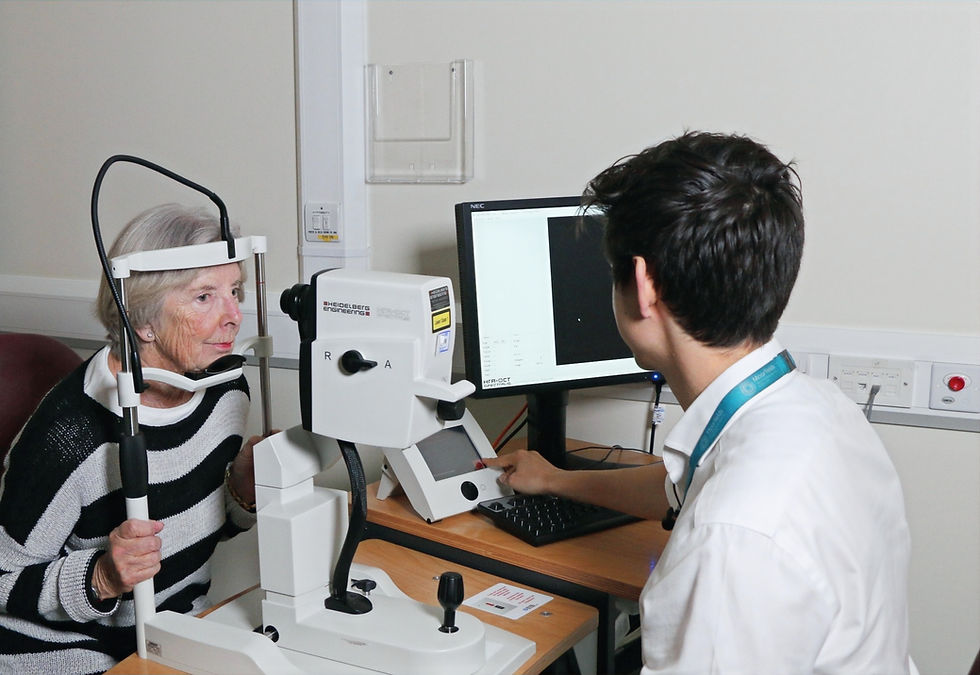
AlzEye has paved the way for several breakthrough studies demonstrating links between retinal biomarkers and systemic conditions, including Parkinson’s, schizophrenia, renal disease, and, most recently, atrial fibrillation. To expand the potential for Oculomics through enriched data, new linkages are being explored through INSIGHT, notably linking AlzEye’s longitudinal eye imaging and systemic health data with corresponding brain imaging data, and with genomics data.
Beyond this work, researchers are exploring the potential of Oculomics to solve pressing public health challenges. These projects are not limited to funded centres of clinical research expertise but extend to community settings in underserved regions where resources are limited.
Health equity in Oculomics
In the largest, most detailed prospective Oculomics study instigated to date globally, the Africa Oculomics Research Programme (AORP) aims to improve health outcomes for African populations by studying the connection between eye health and systemic health over 8 years.
Funded by the Wellcome Trust, the programme is led by partner organisations in London and Uganda, including London School of Hygiene & Tropical Medicine, Pearse Keane’s lab at UCL IoO and Makerere University in Kampala. The initiative will nest an Oculomics study within the General Population Cohort, a community based platform in rural Uganda with a well-established cohort of around 12,000 adults.
The programme will assess the changes in ocular markers and retinal images in the cohort and then match these to changes in their general health, for cardiovascular, renal, and liver disease, stroke, neurodegeneration, mental health, peripheral neuropathy and musculoskeletal disorders. It will also include a subset for maternal health, including pre-eclampsia prediction. The AORP will also use genetic data to make further associations between ocular changes and diseases and deepen understanding of the interplay between them. AI models, including RETFound, will be fine-tuned and validated using the collected data for the analysis. The project will also explore how the findings and associated tools can be used in real-world settings in the project area to diagnose conditions using cost-effective imaging and AI.
From a UK perspective, as outlined by colleagues in a recent commentary, we benefit from the NHS with longitudinal records, ophthalmic imaging captured at population scale, mature governance for secure access to linked health data, decades of experience in delivering screening programmes, and a primary care optometry network that delivers a substantial proportion of eye care.
Leveraging the NHS
Writing for the Nature journal Eye, Siegfried Wagner, Pearse Keane and Alexander Heatley position the UK as ideally positioned to translate Oculomics from hypothesis to clinical care through the NHS. They trace the field’s progress from proof of concept findings, such as Poplin’s finding that fundus images encode cardiovascular signals, to foundation models trained on millions of retinal images and validated for ocular and systemic disease prediction. RETFound is a prime example, trained on 1.6 million colour fundus and OCT images, and validated for ocular and systemic disease.
Despite a growing evidence base for the use of Oculomics in patient care, the literature consistently underscores the need for prospective validation, external generalisability and evidence of clinical utility .“The risk is that algorithmic enthusiasm outpaces clinical pathway design,” the authors caution.
To counter the rush to deployment, they outline four priorities:
Prospective validation in representative NHS populations.
Transparent reporting of model performance, including subgroup analyses and failure modes.
Patient and public involvement in data access, consent models and acceptable use cases.
Implementation studies that measure accuracy alongside clinical utility, cost-effectiveness, workload and equity.
Target product profile and public involvement
As one means of delivering progress across these priorities, Ariel Ong from Pearse Keane’s lab at the IoO and Moorfields Eye Hospital has highlighted the advantage of tools such as Target Product Profiles (TPPs), which are well-established in pharma and recommended under FDA regulatory guidance in the US. TPPs guide product development and evaluation by laying out the requirements necessary for successful implementation - defining performance, safety profile, intended use and clinical specifications, regulatory strategy, cost and adoption. This could help to accelerate the development of Oculomics AIaMDs that align with market and stakeholders’ needs.
The design of target product profiles naturally involves the end user of AIaMD, not only clinicians and health professionals, but, most importantly, members of the public.
Through a current initiative funded by an EPSRC grant, researchers in the Pearse Keane lab at UCL IoO and Alastair Denniston at University of Birmingham are building on previous joint work to develop a TPP for Oculomics AIaMD that can be implemented as a screening tool at community level through optometry.
In the first part of the project, research fellow Sophie-Christin Ernst set out to define a use case supported by current evidence, addressing unmet clinical need and aligned with NHS realities. A rapid scoping review mapped the current oculomics landscape, while targeted searches captured demand and NHS strategic priorities. A multi-stakeholder Research Steering Group, including members of the public, refined and validated the criteria used to assess candidate use cases. The group voted on five use cases and selected cardiovascular and stroke risk prediction as the one to take forward.
The TPP now under development specifies what such a tool would need to do to be fit for purpose in that single, defined use case: what it should predict over what period, how well it must perform and against which existing risk tools, what it requires at the point of image capture, who acts on a result and through what pathway, and what would make it acceptable, equitable and trustworthy. Technical requirements for the underlying model — performance thresholds, validation standards and requirements for consistent performance across population subgroups — are also specified within the TPP

This approach could serve as a blueprint for the adoption of Oculomics in real-world care in the coming years, especially as regulators increasingly prioritise public involvement and engagement. Newly released recommendations for AIaMD from the UK regulator MHRA include proactive public involvement and engagement, which they say should be routine, and inclusive of underrepresented groups, since trust depends on equity, not just safety. Using the TPP profile as an overarching framework for Oculomics implementation appears a promising avenue, positioned to answer the most pressing questions in bringing Oculomics models to market.
As Siegfried Wagner, Pearse Keane and Alexander Heatley have argued, “the questions that matter are not computational but clinical.” Most importantly, four questions need answering. First, clinical utility: does a positive oculomics prediction benefit patients? Second, equitable performance: does it perform consistently across ethnic, socioeconomic and disease subgroups, and where it does not, how is that disclosed and mitigated? Third, health economics: do the downstream investigations and workload generated by an oculomic prediction deliver value at acceptable cost within finite NHS budgets? Finally, pathway development: which clinician owns the result, what is the onward referral route, and how does the prediction integrate with existing services?


